


 Barker Research · Published October 18, 2026 ·
One long, one short: the losing leg earns PAPER, the winning leg pays for it
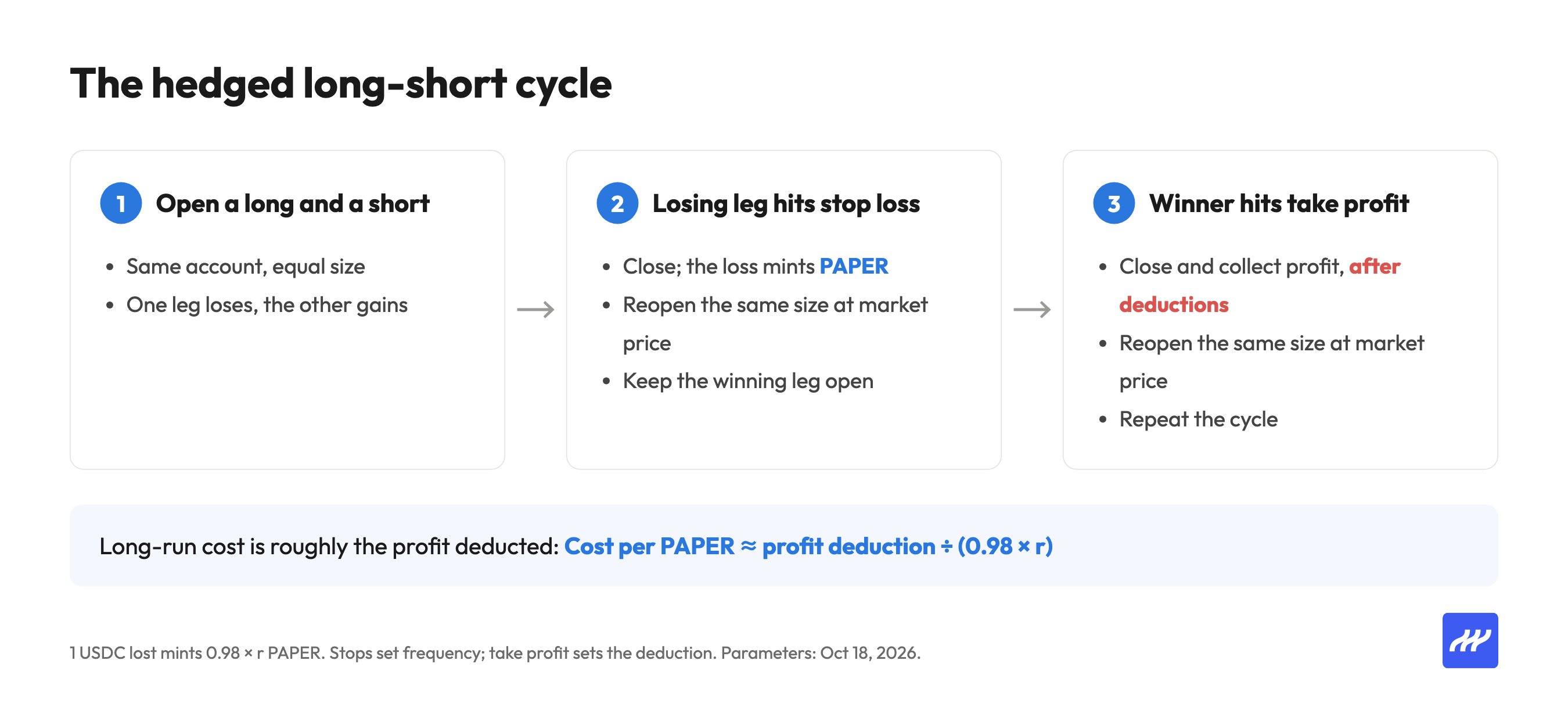
Open a long and an equally sized short in the same account. Whichever way the price moves, one leg loses and the other gains.
- Losing leg: close it at the stop-loss threshold. The loss mints PAPER under the protocol's rules, then reopen the same-sized leg at the current price.
- Winning leg: close it at the take-profit threshold, collect the profit and reopen at the current price.
The account as a whole is hedged against large directional price moves. The losing leg continually generates PAPER, while the winning leg offsets those losses.
Costs come from two sources: profit deductions and liquidation
If profits were paid in full, the two legs would offset each other and PAPER would be almost free. In practice, there are two sources of loss:
- Part of the profit is deducted when a winning position closes. Paper applies its impact curve to the payout, then charges a profit fee. Smaller take-profit moves suffer larger deductions: at a 0.6% take-profit threshold, approximately 84%–85% of gross profit is retained; at 0.2%, approximately 77%–80% is retained.
- Liquidation. The liquidation distance is "1 / leverage − 0.05%." At 100× leverage, a 0.95% price move causes liquidation. The liquidated leg loses its entire margin, while the opposing leg earns only the profit corresponding to the move up to that liquidation threshold.
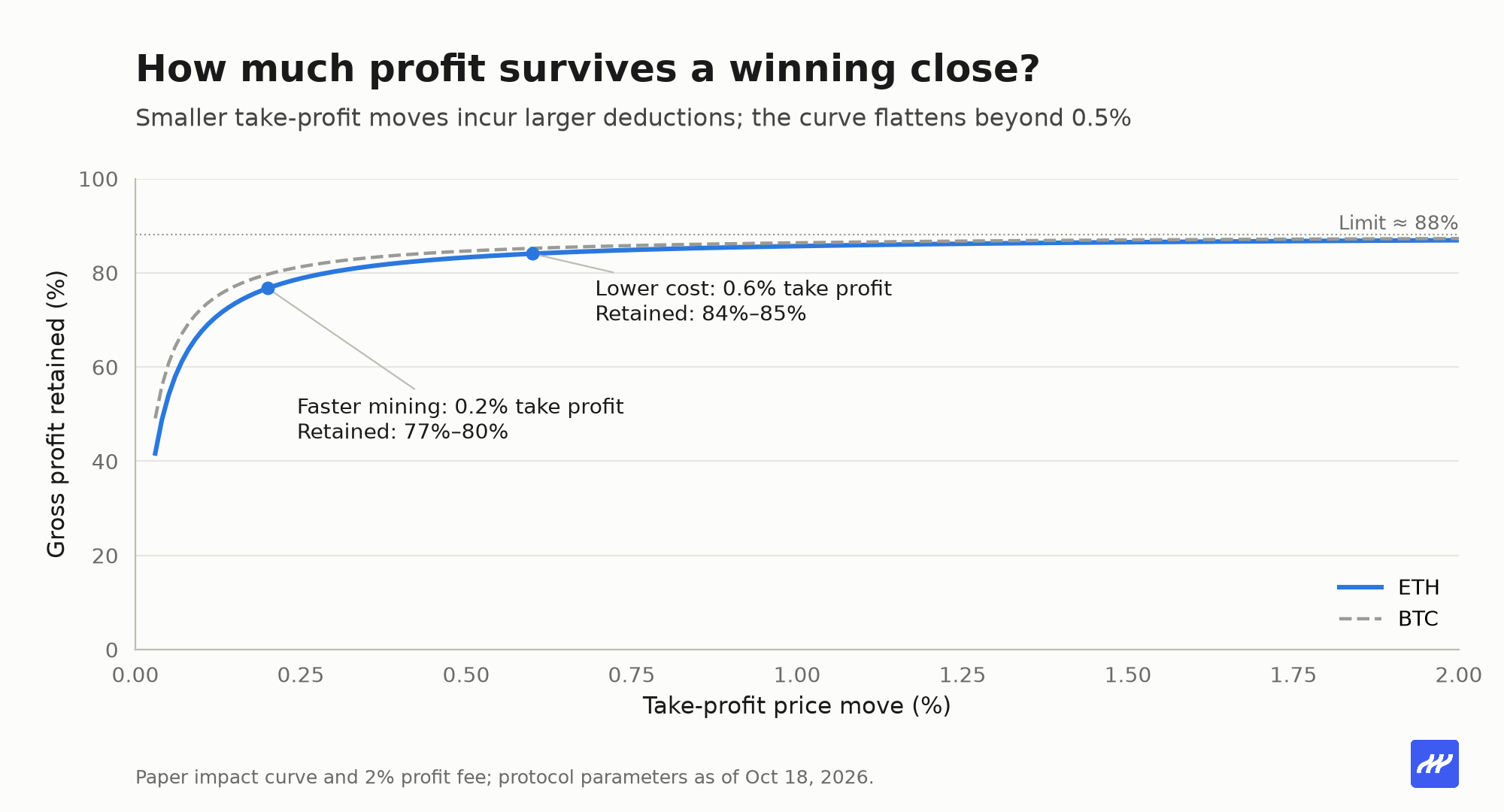
Provided liquidation is avoided, the long-run cost is approximately the deducted portion of the winning leg's profit:
Cost per PAPER ≈ profit-deduction fraction ÷ (0.98 × r)
The stop-loss threshold does not appear in this formula. It determines trading frequency and how much room each leg has before liquidation.
A declining reward rate raises the cost of each PAPER
The reward rate r is determined by cumulative eligible losses H across the platform: r = 100 / (1 + H / 120 million)². The more traders collectively lose, the lower r becomes. From October 14 to 18, PAPER minted per 1 USDC lost fell from 22.0 to 11.7, raising the cost per token for the same strategy settings.
Under this curve, supply has a theoretical ceiling: at most 12 billion tokens from the curve, plus approximately 660 million issued early on, or roughly 12.7 billion in total. Approximately 8.5 billion had been issued by October 18. The exception is when House equity falls below $2M: until it recovers to $2M, each dollar lost mints a fixed 100 PAPER, and that issuance is outside the ceiling.
Settings: stop losses before liquidation and take profits where deductions flatten
The settings serve two purposes. Keep every leg away from liquidation by placing its stop loss inside the liquidation threshold, and reduce cost by taking profit where the deduction curve has flattened. The stop loss can be tighter than the take profit: tighter stops trigger more often and produce PAPER faster.
When take profit is wider than stop loss, the cycle works like this: after a 0.3% move, the losing leg stops out, earns PAPER and immediately reopens at the current price, while the winning leg stays open. If the move continues, the winning leg takes profit at 0.6%. If the market reverses, the newly opened leg becomes the winner and continues accumulating profit until a leg hits its take-profit threshold.
The tool includes two presets, estimated using October 18 parameters:
| Preset | Take profit / stop loss | Leverage | Liquidation distance | Cost per PAPER (ETH) | Cost per PAPER (BTC) |
|---|---|---|---|---|---|
| Lower cost | 0.6% / 0.3% | 100× | 0.95% | ≈ 0.0139 USDC | ≈ 0.0129 USDC |
| Faster mining | 0.2% / 0.2% | 200× | 0.45% | ≈ 0.0202 USDC | ≈ 0.0177 USDC |
Lower-cost mining produces tokens more slowly but more cheaply; faster mining produces more tokens at a higher unit cost. Leverage itself does not change the cost per PAPER: it changes margin requirements and distance to liquidation. The account also needs a cash reserve. A stopped-out leg returns only its margin minus the loss, reopening requires cash, and profit payouts may be queued. One-click setup calculates margin per leg and the reserve from the total allocation.
Observed costs: approximately 0.007–0.014 USDC per PAPER for hosted users
Using Paper's public fill records, we compared actual same-day costs for users of Barker's hosted service and the PaperStrategy vault (paperstrategy.xyz). PaperStrategy uses vault funds to mine PAPER on Paper; all 30 of its publicly disclosed accounts are included. Both sides are measured from actual fills, including trading fees, profit fees, execution deviations caused by queueing and liquidations. Only positions closed on the day are counted.
| Date (Beijing time, 2026) | PAPER mined by Barker hosted users | Cost per PAPER | PAPER mined by PaperStrategy vault | Cost per PAPER |
|---|---|---|---|---|
| October 14 | 2.20M | 0.0074 | 10.66M | 0.0080 |
| October 15 | 3.02M | 0.0137 | 22.55M | 0.0098 |
| October 16 | 2.09M | 0.0129 | 9.46M | 0.0156 |
| October 17 | 1.66M | 0.0121 | 1.82M | 0.0147 |
| October 18 | 1.46M | 0.0125 | 4.45M | 0.0170 |
Quantities are in PAPER; costs are in USDC per PAPER.
October 15 had the worst queueing and the most liquidations on Paper, raising our costs that day. Reward rates were declining daily, and the two groups had different distributions of trading activity across days. A pooled, multi-day average is therefore not comparable; we compare the two groups on the same day.
For reference, acquiring PAPER through unhedged losses on October 18 cost about 0.086 USDC per token. At the PSTR price as of October 19, 00:15 Beijing time, buying PSTR to gain indirect exposure to PAPER implied a cost of approximately 0.048 USDC per PAPER, including the 10% purchase tax and subject to price changes.
PAPER's dividends also change. Lower weekend activity means fewer dividends and a different payback time.
Execution risk: queued orders can leave the legs out of sync
- Execution prices differ from trigger prices. Every Paper order enters a queue, with delays ranging from seconds to minutes. A stop loss can lose more than intended, a take profit can realize less, and a position can be liquidated before its stop-loss order fills.
- Directional exposure can emerge. One leg may fill while its hedge is rejected, or the account may lack enough margin to reopen. By default, if reopening fails, the tool closes the other leg and stops rather than silently leaving a single open leg.
- Use confirmed positions and Paper's own accounting. A trade counts as filled only when the position appears in the account; signed requests are not resent. P&L, fees and minted PAPER all come from Paper's fill records.
- Stops and take profits do not execute while the process is stopped. If the computer sleeps or the process exits, positions remain open on Paper without that protection.
Only allocate money you can afford to lose entirely.
paper-farm-local: run it on your own computer
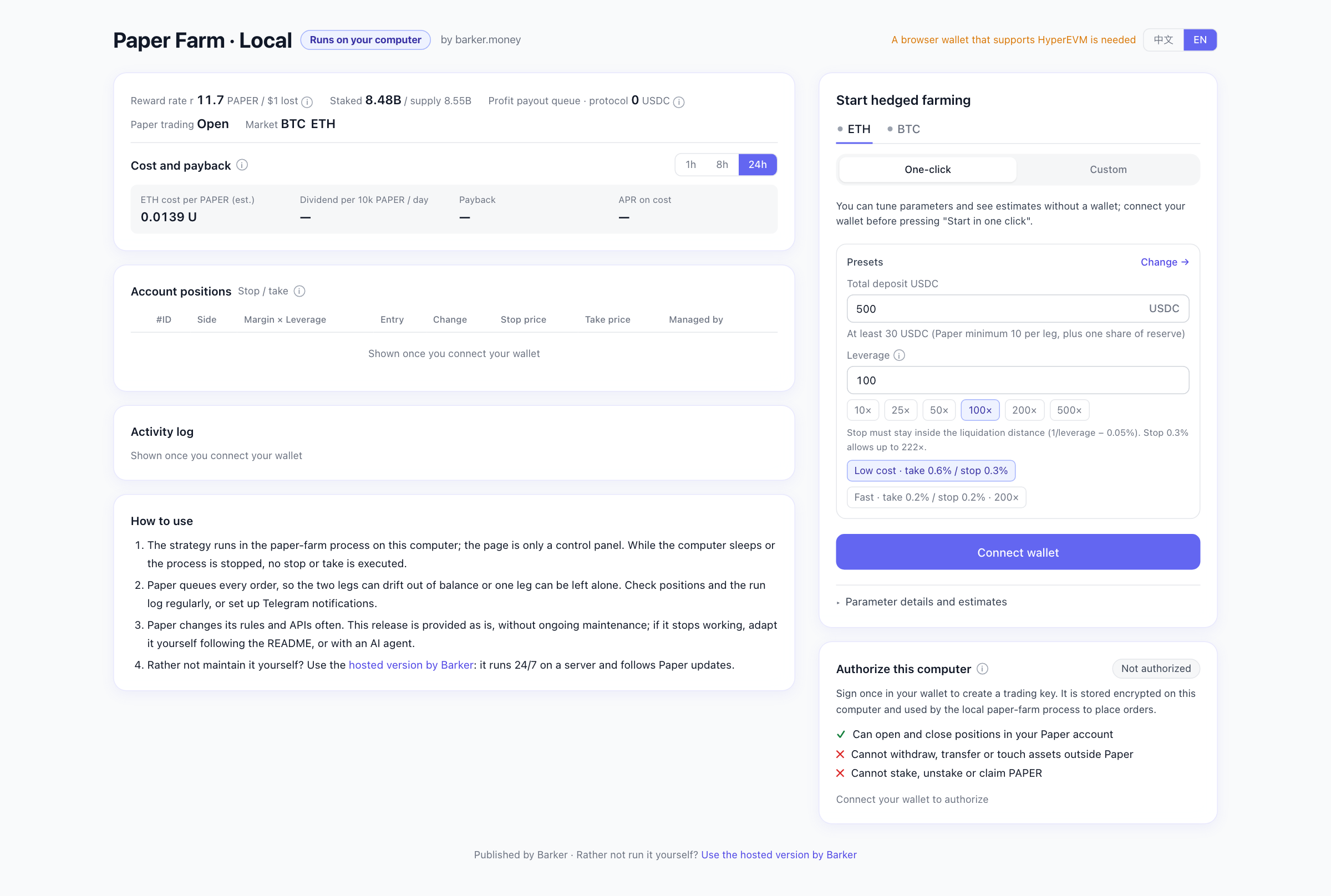
paper-farm-local uses the same execution and accounting code as the hosted service. It runs as a Node process on your own computer and includes a browser-based control panel:
- Authorization: sign a session-key authorization with your browser wallet for 24 hours, three days or seven days. The key can only open and close positions in your Paper account; it cannot withdraw, transfer, stake or claim. It is encrypted locally and can be revoked at any time.
- Features: ETH/BTC switching, one-click setup, two presets, cost estimates, positions, activity logs and daily costs, optional Telegram notifications, and Chinese and English interfaces. It can also set stop losses and take profits for any individual Paper position.
- Maintenance: provided as is, without ongoing maintenance. Paper's rules and APIs change frequently. If it stops working, you can modify it yourself or ask an AI coding agent to troubleshoot and adapt it using the README and the repository's agent skill.
- License: PolyForm Noncommercial 1.0.0. Free for personal, noncommercial use. Commercial use, including paid or hosted services, is prohibited.
If you prefer not to keep your computer running, Barker also offers a hosted service that runs on servers around the clock and follows Paper's updates.
Data Sources
- Reward rate, impact-curve parameters and PAPER supply: Paper's public protocol parameters, October 18, 2026.
- Preset cost estimates: paper-farm-local calculations using Paper's live parameters, October 18, 2026.
- Observed costs: public Paper fill records for Barker hosted-service users and PaperStrategy's 30 public accounts, grouped by calendar day in Beijing time.
- PSTR implied cost: PSTR market capitalization and the vault's USDC and PAPER holdings, from paperstrategy.xyz, October 19, 2026, 00:15 Beijing time.
All data in this report comes from public disclosures and public on-chain data. It is not investment advice. Papertrade was recently launched at the time of writing; rules, reward rates and APIs may change at any time.